Mass Defect
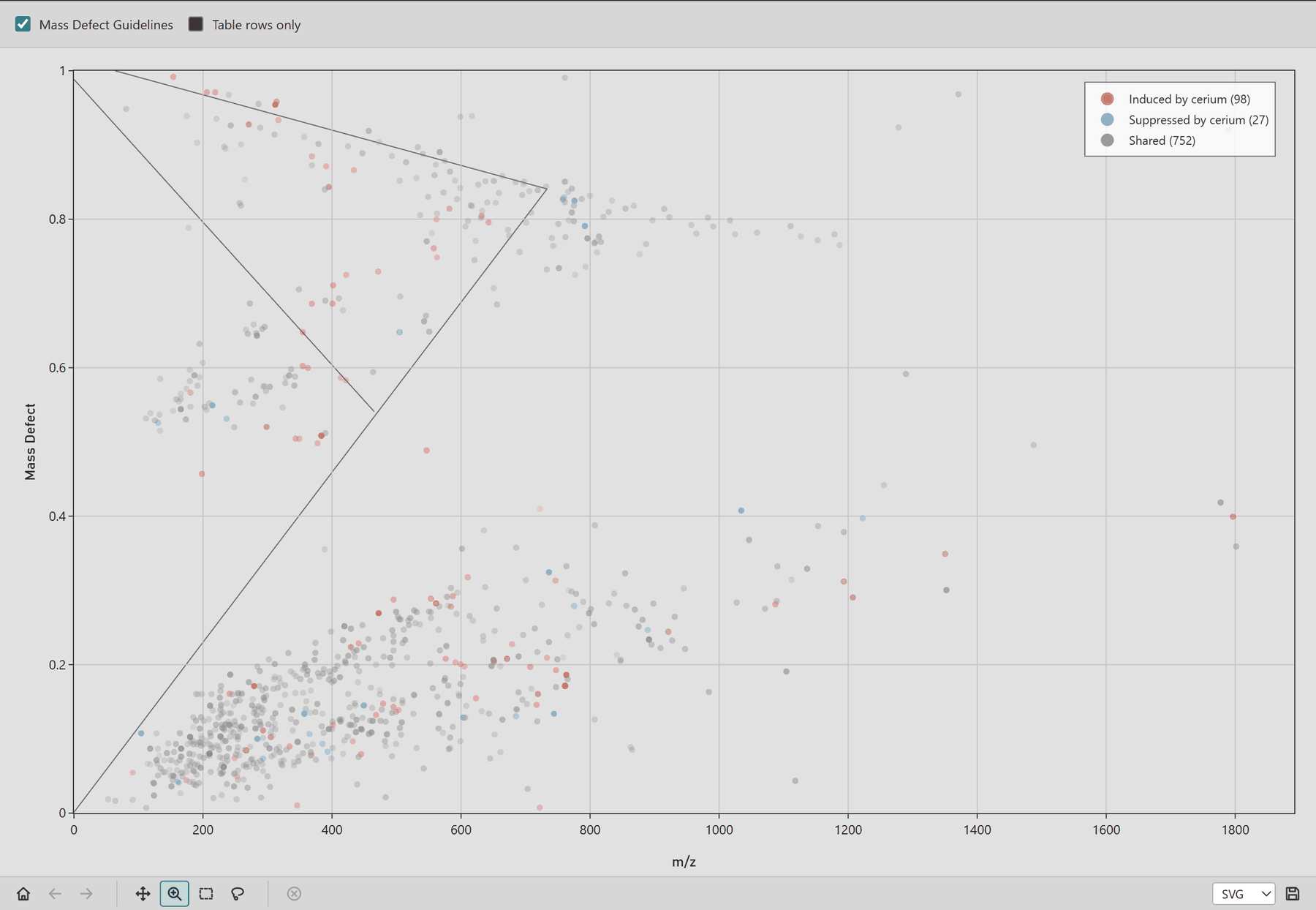
Each feature's mass defect (its m/z minus the nominal, integer mass) against its m/z, coloured by Plot Feature Set.
Why mass defect is useful
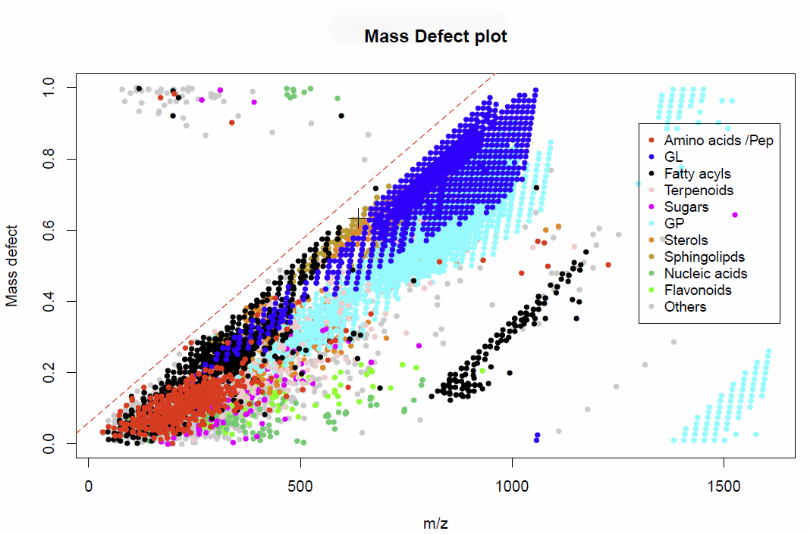
A given chemical change (adding a methyl group, hydrogenation, hydrolysis) always shifts mass and mass defect by the same amounts. Families of related compounds therefore line up along the same slope, which makes the plot useful for spotting compound series and prioritizing features.
Elements contribute differently to mass defect per dalton of mass. Hydrogen is strongly positive (+7.825 mDa/Da), carbon is zero by definition, and heavier atoms are increasingly negative (nitrogen +0.220, oxygen −0.317, sulfur −0.873 mDa/Da). So the slope a series traces hints at its chemistry:
- Low slope: heteroatom-rich compounds such as nucleotides and carbohydrates, or hydrogen-poor cyclic polyketides.
- High slope: hydrogen-rich compounds such as hydrocarbons, fatty acids and other lipids.
Guidelines
Mass Defect Guidelines draws three reference lines: saturated hydrocarbons, perbromocarbons and polycarbonic acids.
- Singly charged ions made of C, H, N, O, P and S fall between the hydrocarbon line and the polycarbonic acid line.
- Heavily halogenated, hydrogen-poor compounds fall between the polycarbonic acid and perbromocarbon lines.
- Singly charged ions made of C, H, N, O, P, S, Cl and I cannot fall between the perbromocarbon and hydrocarbon lines.
Wrap-around
Nominal mass is the floor of the m/z, so mass defect always lies between 0 and 1. A compound rich in halogens or heteroatoms can have a small negative true mass defect, which appears just below 1. Many large molecules, such as long fatty acids, have a true mass defect above 1, which wraps around to a small value.
Two common patterns: a series with a negative slope near the top of the plot is usually salt clusters, and a cloud about 0.5 below the main cluster is usually doubly charged ions.