Filtering Settings
MPACT removes four kinds of unwanted features before computing statistics. Each filter can be turned off. The Data Review tab reports how many features each one removed.
Mispicked peaks
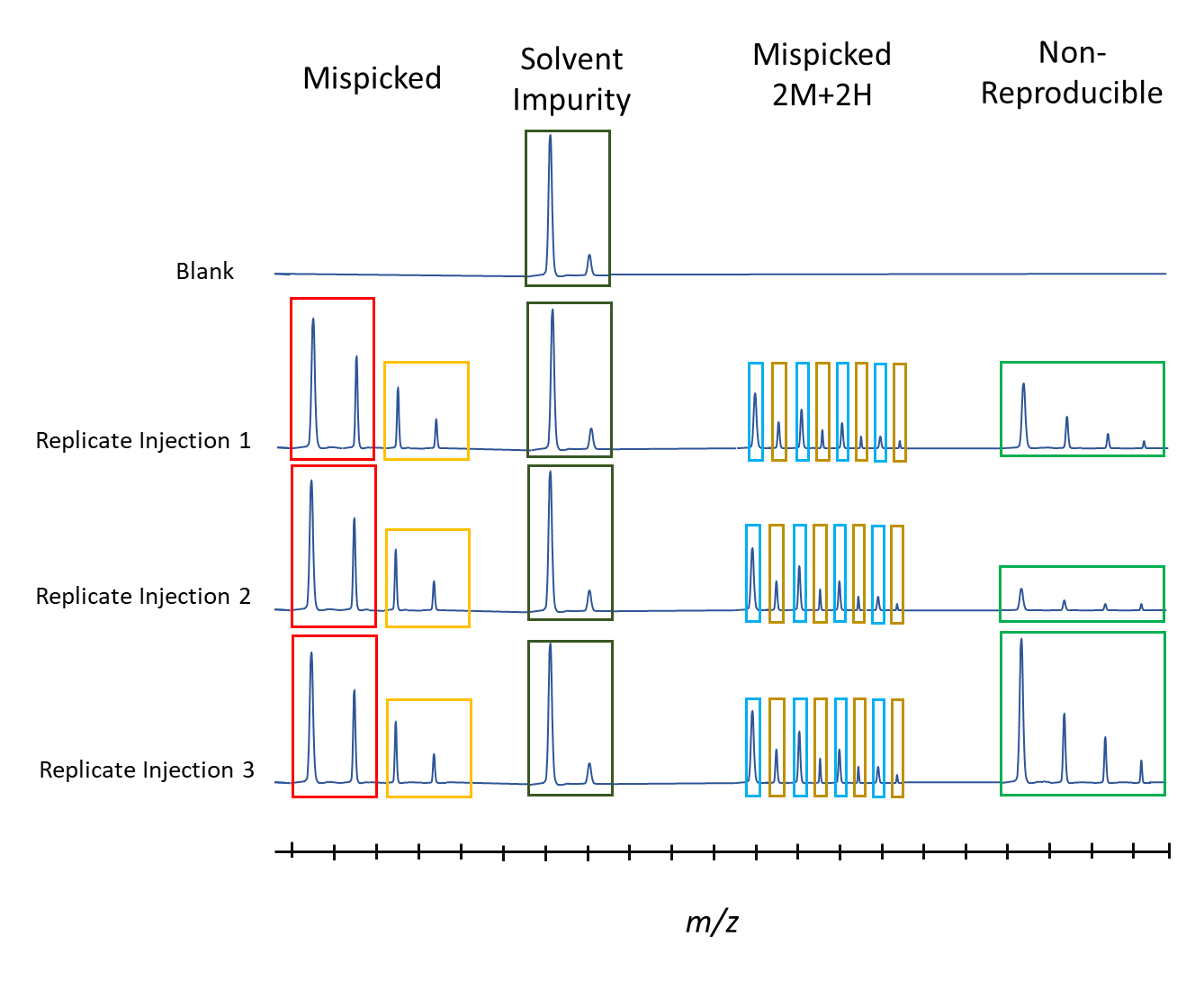
A mispicked peak is a feature that is really part of another, more abundant feature at a lower m/z and the same retention time. Common causes are an isotope pattern split into several features during peak picking, FT-MS ringing artifacts beside an intense peak, and doubly charged dimers.
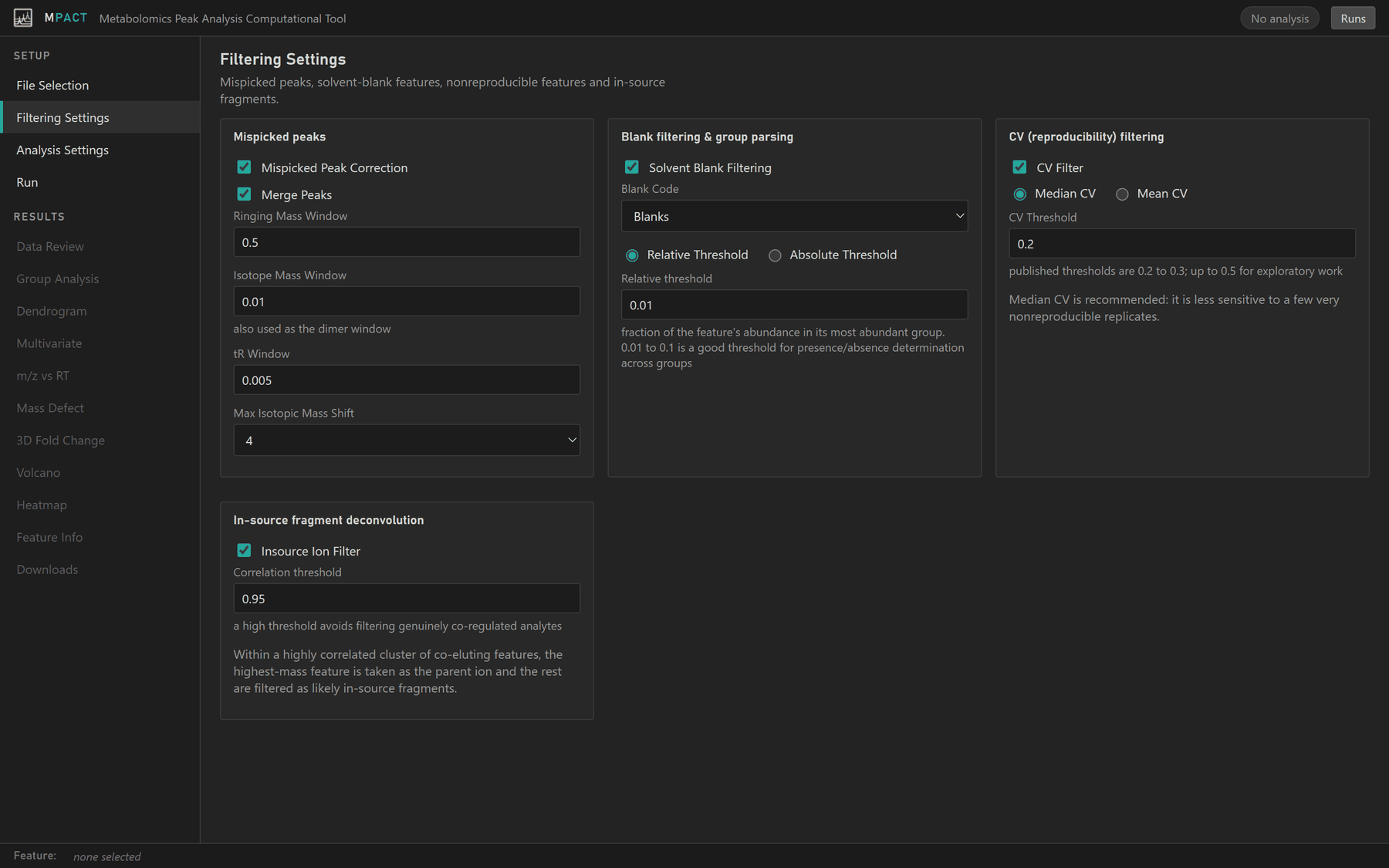
| Setting | Default | Meaning |
|---|---|---|
| Mispicked Peak Correction | on | Detect mispicked peaks and remove them |
| Merge Peaks | on | Add a mispicked peak's abundance to its parent feature instead of discarding it |
| Ringing Mass Window | 0.5 | Width (Da) of the mass-difference bands that count as ringing or isotope peaks |
| Isotope Mass Window | 0.01 | Tolerance (Da) for isotope spacing; also used for the half-integer offset of doubly charged dimers |
| tR Window | 0.005 | Maximum retention-time difference (min) from the parent |
| Max Isotopic Mass Shift | 4 | How many Da above the parent to look |
The defaults are deliberately conservative, so that closely related but genuinely different compounds are not merged.
Blank filtering and group parsing
Solvent Blank Filtering removes features present in the group chosen as Blank Code.
The threshold below it decides when a feature counts as present in a group. It is used for blank filtering and also for every group comparison later on: the Plot Feature Sets, the UpSet plot and the "Detected in" lists.
- Relative Threshold (default 0.01): a fraction of the feature's abundance in its most abundant group. 0.01 to 0.1 is a reasonable range. A value of 0.05 means a feature found in the blank at more than 5% of its highest group abundance is treated as a blank feature.
- Absolute Threshold: a raw or normalized abundance value.
CV (reproducibility) filtering
Removes features whose coefficient of variation (relative standard deviation) across technical replicates is above the CV Threshold (default 0.2).
- Median CV (recommended) uses the median across samples, so one badly reproduced sample does not remove an otherwise good feature.
- Mean CV uses the mean.
Published thresholds are usually 0.2 to 0.3. For exploratory work, few samples or chemically diverse extracts where many features appear in only a few samples, up to 0.5 can be appropriate. The Dendrogram helps choose: pick the least strict threshold beyond which technical replicates stop clustering together any better.
Peak picking thresholds change the CV plot
The intensity threshold used for peak picking in Progenesis, MZmine or MS-DIAL has a large effect on the CV plot. Picking lower-intensity peaks necessarily brings in more noise-like and artifact peaks, which are poorly reproducible, so the curve looks worse and the quality scores drop. The reproducible features are still kept correctly: the CV filter removes the added noise, and the features that pass are the same reproducible subset.
In-source fragment deconvolution
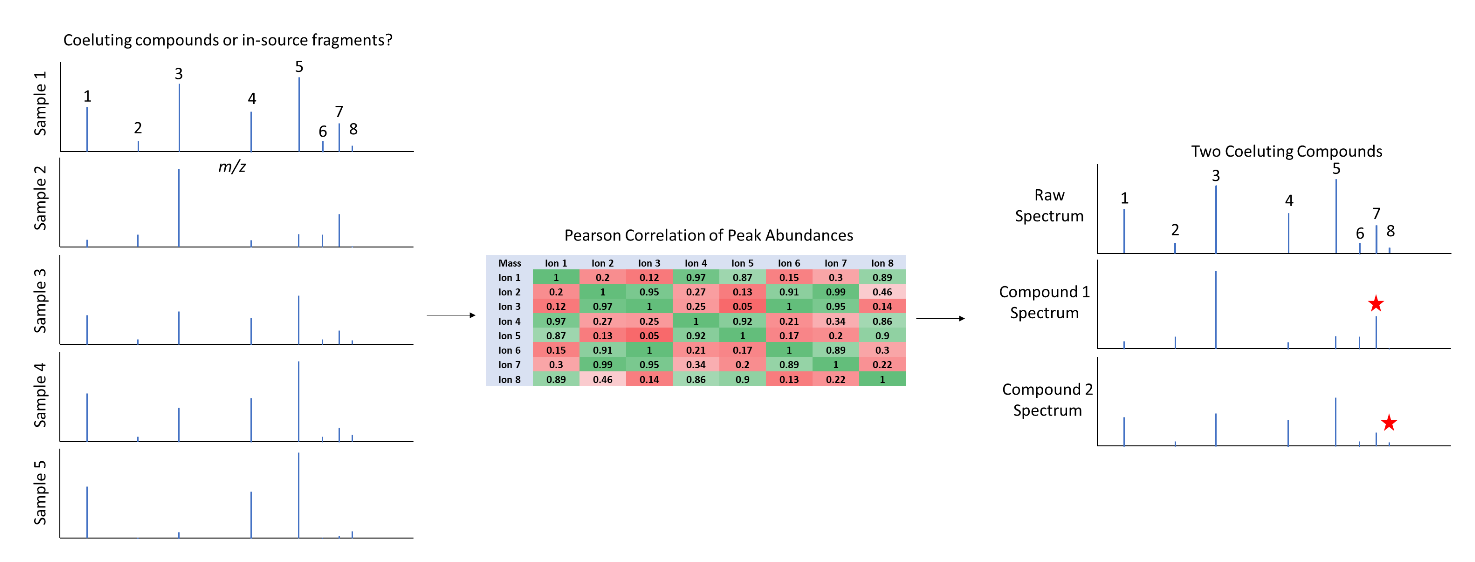
In-source fragments are ions that break off a molecule in the ion source, so they appear as separate features at the same retention time. MPACT builds correlation matrices of features within narrow retention-time windows. Within a cluster of co-eluting features whose abundances correlate above the Correlation threshold (default 0.95), the highest-mass feature is kept as the parent ion and the rest are removed.
Keep the threshold high. A low value removes genuinely different compounds that happen to rise and fall together across samples.